
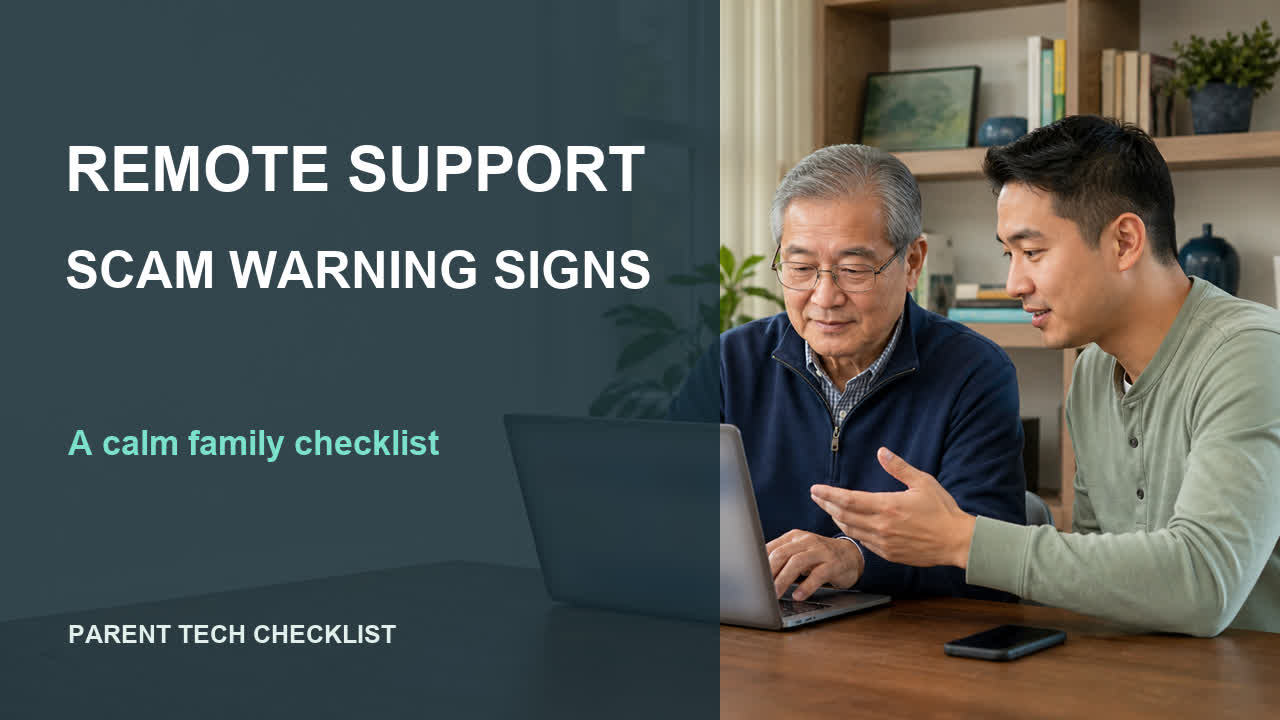
The family question
How can a parent tell trusted family help from an unexpected support caller? Separate planned family support from unexpected remote access. This guide is for a household where an unsolicited caller says the computer or phone is infected. For Remote Support Scam Warning Signs, the goal is one repeatable task the account owner understands, not a broad device overhaul.
Before you begin
Do not install software; close the message and call a family helper using a saved contact. Before changing anything for Remote Support Scam Warning Signs, agree on the exact result and keep a working contact method available in case the task needs to pause.
Three safe steps
1. Unexpected support is not trusted.
Begin with the parent beside you and unexpected support is not trusted. For remote support scam warning signs, record the caller's claim, the screen that appeared and whether anything was installed; keep passwords, recovery codes and private answers off the worksheet. The checkpoint is simple: the device remains usable without granting new remote access.
2. Do not install tools for a caller.
Next, do not install tools for a caller. For remote support scam warning signs, compare what appears on the device with the official guidance below, not with instructions from an incoming message or caller. Disconnect from the network and seek official support if software was installed or credentials were entered.
3. Use a saved family contact.
Finish by use a saved family contact. Ask the parent to repeat the result without coaching, then add the date beside the caller's claim, the screen that appeared and whether anything was installed. If the remote support scam warning signs task cannot be repeated, return to the last working state and use the official support route.
If it does not go as expected
Disconnect from the network and seek official support if software was installed or credentials were entered. While working on Remote Support Scam Warning Signs, a warning, unfamiliar login screen or unexpected request for private information is a reason to pause, document what is visible and return through an official support page.
Make the family handoff clear
Write down the caller's claim, the screen that appeared and whether anything was installed and the name of the approved helper. The Remote Support Scam Warning Signs handoff is complete only when the device remains usable without granting new remote access. Review this topic note after a relevant device, account or caregiver change.
Printable family checklist
- How can a parent tell trusted family help from an unexpected support caller?
- Unexpected support is not trusted.
- Do not install tools for a caller.
- Use a saved family contact.
- We recorded the caller's claim, the screen that appeared and whether anything was installed.
- The account owner understood every change.
- We tested one normal task after the change.
Official sources
Product screens change. For Remote Support Scam Warning Signs, open these primary sources directly and verify that the instructions still match the device before acting.
- FTC: Tech Support ScamsPrimary guidance used to review Remote Support Scam Warning Signs.
- CISA: Recognize and Report PhishingPrimary guidance used to review Remote Support Scam Warning Signs.
Safety boundary
This Remote Support Scam Warning Signs checklist is general technology education for families, not medical, legal, financial, security or emergency advice. If an active outage, recall, scam notice or security advisory affects this topic, use the current official source and follow its stated instructions.